

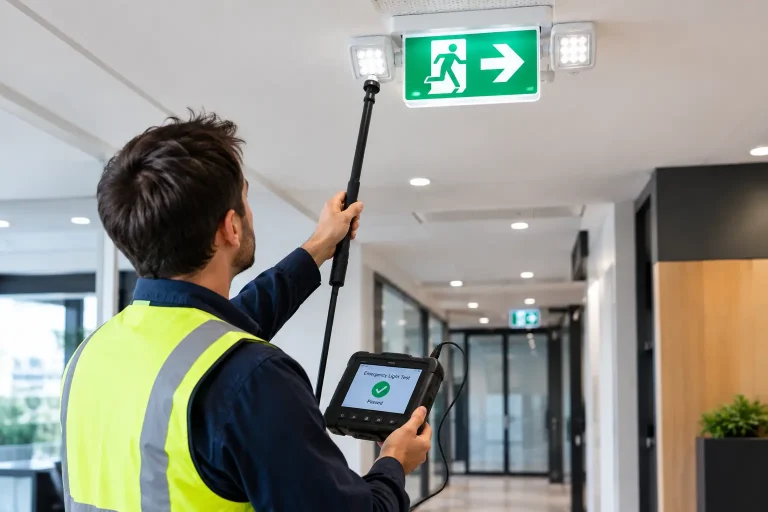
Emergency lighting plays an important role in keeping people safe when normal lighting fails. In commercial buildings, offices, warehouses, retail premises and other workplaces, emergency lighting helps occupants identify exits, evacuation routes and potential hazards during a power outage or emergency.
But what are the emergency lighting testing requirements in Australia? How often should emergency lights be tested, what does an inspection involve, and what should businesses do when emergency lighting fails?
This guide explains the key considerations for emergency lighting testing in Australian commercial buildings and workplaces, with a focus on practical electrical safety and compliance.
What Is Emergency Lighting?
Emergency lighting is designed to provide illumination when the normal lighting supply fails.
Depending on the building and installation, emergency lighting can help:
- Illuminate evacuation paths
- Identify emergency exits
- Reduce the risk of trips and falls
- Help occupants safely leave a building
- Provide visibility during a power failure
- Support emergency evacuation procedures
Emergency lighting can include illuminated exit signs as well as emergency luminaires installed along designated evacuation routes.
For commercial property owners and facility managers, maintaining these systems is an important part of an overall building safety program.
Why Is Emergency Lighting Testing Important?
Emergency lighting may sit unused for long periods, which means a fault may not become obvious until there is an actual power failure.
A fitting may look operational during normal conditions but still have an issue with its battery, charging system, lamp, circuitry or emergency operation.
Regular inspection and testing helps identify problems before an emergency occurs.
Testing can help businesses:
- Identify failed emergency lights
- Detect battery problems
- Confirm emergency operation
- Identify damaged fittings
- Maintain testing records
- Support workplace safety procedures
- Reduce the risk of unexpected failures
- Demonstrate that electrical safety systems are being maintained
Emergency lighting should therefore be treated as part of an ongoing building maintenance and electrical safety program rather than a one-off installation requirement.
Emergency Lighting Testing Requirements in Australia
The requirements for emergency lighting depend on the building, installation, applicable legislation, standards and the intended use of the premises.
Australian emergency lighting installations are commonly designed and maintained with reference to standards including AS/NZS 2293, which covers emergency escape lighting and exit signs.
The relevant requirements can include provisions for:
- Emergency escape lighting
- Exit signs
- Routine inspection
- Testing
- Maintenance
- Record keeping
- System performance
Businesses should not assume that every property has exactly the same testing requirements. Building owners, facility managers and responsible persons should consider the requirements applicable to their particular building and installation.
How Often Should Emergency Lighting Be Tested?
One of the most common questions about emergency lighting testing Australia is how frequently testing should occur.
Testing schedules depend on the applicable requirements, building type, emergency lighting system and relevant standards.
Routine checks may include regular inspections and functional testing, while more comprehensive discharge testing may be required at specified intervals.
The important point is that emergency lighting should be tested according to the requirements applicable to the installation rather than relying on an informal schedule.
A professional electrical contractor can help businesses determine an appropriate inspection and testing program.
What Does Emergency Lighting Testing Involve?
Emergency lighting testing involves checking whether the system performs as intended when normal power is unavailable.
Depending on the system and applicable requirements, testing may include several areas.
1. Visual Inspection
The first step is checking the physical condition of emergency lighting equipment.
This can include looking for:
- Cracked or damaged fittings
- Broken diffusers
- Damaged exit signs
- Loose components
- Obstructions
- Signs of overheating
- Physical deterioration
- Incorrect or damaged signage
Visual inspections can identify problems before electrical testing is performed.
2. Functional Testing
Emergency fittings can be tested to determine whether they operate correctly when the normal lighting supply is interrupted.
The test can help identify:
- Failed lamps or LEDs
- Battery faults
- Charging problems
- Circuit faults
- Fittings that fail to illuminate
- Exit signs that are not operating correctly
3. Battery Testing
Many emergency lighting systems rely on rechargeable batteries.
Over time, batteries can lose capacity and may no longer provide the required duration of emergency illumination.
Battery condition should therefore be considered as part of emergency lighting maintenance.
4. Duration Testing
Depending on the applicable requirements and testing schedule, emergency lighting may need to undergo a longer-duration test to determine whether it can operate for the required period.
This can reveal battery deterioration that may not be obvious during a short functional test.
5. Record Keeping
Testing results should be documented appropriately.
Records can help building managers understand:
- When testing was completed
- Which fittings were tested
- Whether failures were identified
- What corrective work was performed
- When the next inspection or test is due
Good documentation is particularly important for commercial properties with a large number of emergency lighting fittings.
What Happens If Emergency Lighting Fails a Test?
If an emergency light fails testing, the problem should be investigated and rectified rather than simply recorded and ignored.
Possible causes include:
- Flat or deteriorated batteries
- Failed lamps
- LED failures
- Charging circuit faults
- Wiring problems
- Damaged fittings
- Faulty control components
- Electrical supply issues
Depending on the fault, corrective work may involve repairing the fitting, replacing a component, replacing the battery or replacing the complete emergency light.
After repairs, the system should be retested as appropriate to confirm that it operates correctly.
Emergency Lighting Maintenance vs Testing
Testing and maintenance are related but are not exactly the same.
Testing determines whether emergency lighting operates as required.
Maintenance involves repairing, replacing or servicing components when problems are identified.
A good emergency lighting program should include both.
For example, a property manager may discover during testing that several emergency light batteries have deteriorated. Those batteries then need to be replaced and the fittings checked again.
This is why emergency lighting should form part of a wider commercial electrical maintenance strategy.
Emergency Lighting for Commercial Buildings
Commercial properties can contain a large number of emergency lighting fittings across different areas of a building.
These may include:
- Office areas
- Corridors
- Stairways
- Entry and exit points
- Warehouses
- Car parks
- Retail areas
- Storage areas
- Plant rooms
- Common areas
The location and number of fittings can make manual management difficult, particularly for larger properties.
A structured inspection and testing program helps facility managers keep track of emergency lighting across the building.
Emergency Exit Signs and Testing
Exit signs are an important component of emergency evacuation systems.
They help occupants identify designated exits and evacuation routes when normal lighting is unavailable.
During inspections, exit signs should be checked for issues such as:
- Illumination failure
- Damaged signs
- Battery problems
- Physical damage
- Obstructions
- Incorrect positioning
- Electrical faults
An exit sign that appears illuminated during normal operation may still have an emergency-mode fault, which is why appropriate testing is important.
Emergency Lighting and Building Electrical Safety
Emergency lighting is only one component of commercial electrical safety.
Businesses should also consider other electrical systems and equipment, including:
- Switchboards
- RCDs
- Power outlets
- Electrical equipment
- Lighting systems
- Distribution boards
- Cabling
- Portable electrical equipment
A broader building safety review can help identify electrical risks that may otherwise be overlooked.
For a practical overview of electrical checks, see our commercial building electrical safety checklist.
Why Regular Commercial Electrical Inspections Matter
Emergency lighting should not be considered in isolation.
A commercial property contains multiple electrical systems that require appropriate inspection, maintenance and monitoring.
Regular commercial electrical inspections can help businesses identify developing problems before they result in equipment failure, safety risks or unexpected disruption.
For property owners and facility managers, combining emergency lighting checks with a broader electrical compliance program can provide a more complete approach to electrical safety.
Common Emergency Lighting Problems
Failed batteries
Faulty LED or lamp
Charging faults
A fitting may fail to charge correctly, meaning the battery may not be ready when emergency operation is required.
Damaged fittings
Electrical faults
Obstructed lighting
Emergency Lighting Testing Checklist
Commercial property owners and facility managers can use this checklist when reviewing their emergency lighting program:
- Identify all emergency lights and exit signs
- Check fittings for physical damage
- Confirm emergency lights operate when normal power is interrupted
- Check batteries and charging systems
- Inspect exit signs
- Identify failed fittings
- Arrange repairs or replacement where required
- Retest repaired equipment
- Maintain appropriate testing records
- Keep track of future testing requirements
Review emergency lighting as part of the wider building electrical safety program
This checklist is a useful starting point, but it should not replace the requirements that apply to the specific building or emergency lighting installation.
Who Can Perform Emergency Lighting Testing?
Emergency lighting testing should be carried out by an appropriately competent person with the knowledge and equipment necessary for the work.
For commercial properties, engaging a qualified electrical contractor can provide businesses with professional testing, fault identification and electrical maintenance support.
This is particularly useful for larger buildings where emergency lighting systems contain numerous fittings or where faults need to be repaired following testing.
Emergency Lighting Testing in Perth
For businesses in Perth and Western Australia, emergency lighting should be managed as part of a broader electrical safety and compliance program.
Different commercial properties can have different systems, building layouts and operational risks. A professional assessment can help identify what testing and maintenance is appropriate for the installation.
Symbient Electrical provides Compliance Testing services for commercial and industrial businesses across Perth.
Our compliance testing services can help businesses identify electrical safety issues, maintain appropriate testing processes and support ongoing workplace compliance.
How to Stay on Top of Emergency Lighting Compliance
For commercial property owners and facility managers, the easiest way to manage emergency lighting is to make testing part of a documented maintenance program.
A practical approach includes:
1. Create an emergency lighting register
Record the location and identification of emergency fittings throughout the property.
2. Establish a testing schedule
Determine the appropriate testing and inspection requirements for the specific installation.
3. Keep testing records
Document inspections, test results, failures and corrective actions.
4. Repair failures promptly
Do not leave failed emergency lighting unresolved.
5. Retest after corrective work
Confirm that repaired or replaced equipment operates correctly.
6. Review the entire electrical system
Emergency lighting is only one part of commercial electrical safety. Include it within your broader electrical inspection and compliance program.
Final Thoughts
Emergency lighting provides an important safety function when normal lighting fails. For Australian commercial buildings, regular inspection, testing and maintenance can help ensure emergency lights and exit signs remain ready when they are needed.
The exact emergency lighting testing requirements in Australia depend on the building, system, applicable legislation and relevant standards. Businesses should therefore avoid relying on a one-size-fits-all testing schedule.
A structured program that combines inspections, testing, maintenance, record keeping and timely repairs can help commercial property owners and facility managers maintain safer premises and support ongoing electrical compliance.
Is Your Commercial Property’s Emergency Lighting Due for Testing?
Is your commercial property’s emergency lighting due for inspection or testing? Contact Symbient Electrical to discuss your requirements.
FAQs
How often should emergency lighting be tested in Australia?
Is emergency lighting mandatory in commercial buildings?
What is tested during emergency lighting testing?
What happens if an emergency light fails?
How long do emergency lighting batteries last?
Can emergency lighting testing be included in electrical compliance testing?
Yes. Emergency lighting can be included as part of a broader commercial electrical compliance and testing program, depending on the property’s requirements.