

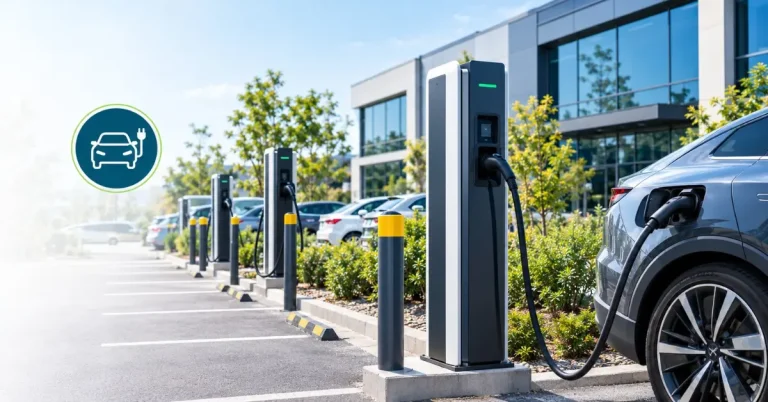
More Australian businesses are adding electric vehicle (EV) chargers, whether for staff, customers or a company fleet. The idea is simple: put a charger in the car park. The planning is less simple, because chargers draw a lot of power and the right setup depends on who will use them and how long vehicles stay.
This guide explains the main options and the steps from first idea to installation, in plain language.
Who will use the chargers?
- Staff who park all day: vehicles are parked for 8 hours or more, so slower chargers work well.
- Customers or visitors: stays are shorter, so faster chargers may be worth it, and you may want a way to charge for use.
- A company fleet: vehicles may need to be full by morning, so plan for overnight charging and enough chargers for the fleet.
- A mix: many sites combine a few chargers for staff with one or two for visitors.
Charger types and power levels
Most workplace chargers are AC chargers that use a Type 2 connector, the standard in Australia. Typical power levels are:
Charger | Supply | Best suited to |
7 kW | Single-phase | Small offices and sites with a standard supply; vehicles parked for many hours |
11 kW | Three-phase | Moderate daily charging |
22 kW | Three-phase | Higher turnover, where vehicles need to charge faster |
As a guide, chargers above about 7.4 kW need a three-phase supply. Whether your site has three-phase power, and how much spare capacity it has, is one of the first things to find out. Our guide to 3-phase power explains the difference.
Faster DC chargers exist but are a much larger investment and usually suit dedicated charging sites, not a typical workplace car park.
Tethered or untethered?
- Tethered chargers have a cable permanently attached, so drivers just plug in.
- Untethered chargers have a socket, and drivers bring their own cable.
Tethered units are more convenient for visitors. Untethered units can be simpler and cheaper, and suit staff who use the same spot each day.
Smart features worth considering
- Load management: shares the available power between chargers so the building’s supply isn’t overloaded when several cars plug in. It matters most when you have more than a couple of chargers.
- Network connection (OCPP): an open standard that lets chargers be monitored and managed remotely, and supports access cards, user billing and fleet software.
Access control and billing: useful if you want to restrict use to staff or charge customers. - Solar integration: some systems can use surplus solar power to charge vehicles.
- Scheduling: charging can be timed for off-peak periods.
Steps to install EV chargers at your business
1. Decide how many chargers you need
A rough guide is one charger for every two to three vehicles if overnight charging is possible, or one per vehicle if vehicles turn over every day. It is cheaper to allow for growth now than to add a second installation later.
2. Check your electricity supply
A licensed electrician will check what your site can deliver: single or three-phase, main switch rating and spare capacity at the switchboard. Existing loads such as air conditioning and machinery matter. If you aren’t sure how much capacity is spare, a commercial load calculation gives a clear answer.
3. Decide whether the switchboard needs work
Adding chargers can use up the capacity that a board has spare. Load management often avoids an upgrade, but for larger installations, an upgrade may be needed. Our guide to commercial switchboard upgrade costs explains what is involved.
4. Choose the location
Good locations are close to the switchboard, which keeps cable runs and costs down, visible and safe for drivers, and protected from knocks. Think about the bays: how many, where, and whether they need signage or wheel stops.
5. Choose the chargers
Pick the power level, tethered or untethered, and the smart features based on the user questions above. Buy from a supplier with local support and a good warranty.
6. Get a quote and a plan
A written quote should cover the chargers, cabling, any switchboard work, load management, commissioning and warranty. Ask what is included and what is extra, such as trenching, signage or line marking.
7. Install and test
A licensed electrician installs and tests the chargers and commissions any network features. Ask for the paperwork, manuals and a handover walk-through.
8. Plan how people will use it
Decide the access rules: who can use the chargers, for how long, whether there is a charge, and what happens to bays that are blocked by uncharged vehicles.
Costs: what affects the price
Prices vary a lot, so ask for a site-specific quote. The main factors are:
- The number and power of the chargers
- The distance from the switchboard, and any trenching or conduit
- Whether switchboard or supply upgrades are needed
- Load management and network features
- Signage, line marking and bay protection
- Whether the installation is on a new or existing building
Grants and incentives
Government grants and incentives for charging infrastructure exist from time to time, but they change regularly. Check current federal and WA programs before you commit, and confirm eligibility before purchase.
Common mistakes
- Not checking capacity first, then discovering the board is full.
- Buying chargers before knowing who will use them.
- No load management on a multi-charger site.
- Too few chargers for the number of vehicles.
- Choosing the cheapest charger with no local support or warranty.
- Placing chargers far from the switchboard, which adds cost.
- Forgetting access and billing, which causes disputes later.
FAQs
Do I need three-phase power for EV chargers?
Not always. A 7 kW charger can run on single-phase, but chargers above about 7.4 kW generally need three-phase.
How many EV chargers does my business need?
It depends on the vehicles. One charger for every two to three vehicles is a common guide where overnight charging is available, or one per vehicle for daily turnover.
Will EV chargers overload my switchboard?
They can if the board has little spare capacity. A capacity check shows whether it is fine, and load management can reduce the need for an upgrade.
What is load management?
It shares available power between chargers so that the combined load stays within the supply limit.
Can I charge customers for using the chargers?
Yes, with chargers that support network connection and billing. Not every charger does, so check this before buying.
Do I need a licensed electrician?
Yes. EV chargers are connected to your electrical supply, so installation must be done by a licensed electrician.
Next steps
If you are thinking about EV charging for your business, the first step is a site check of your supply and switchboard. Speak to our team about commercial electrical services in Perth.