

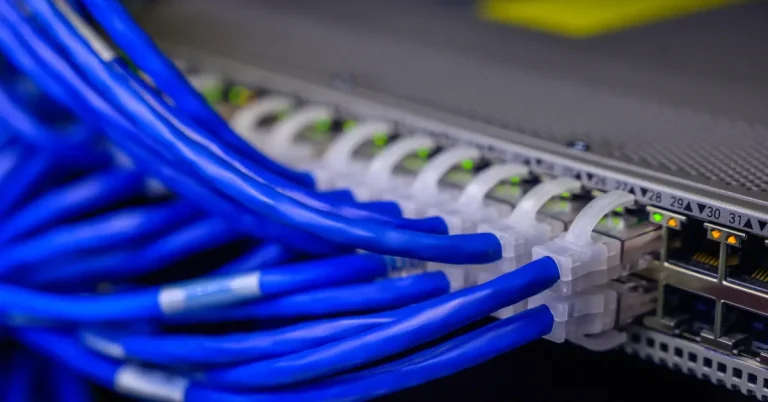
Fibre optic internet is a broadband connection that transmits data as pulses of light through thin glass or plastic fibres, rather than electrical signals through copper wire. The result: dramatically faster speeds, lower latency, and rock-solid reliability — making it the gold standard for internet connectivity in Australia and worldwide.
Australia’s appetite for faster, more reliable internet has never been greater. Remote work, 4K streaming, smart homes, and cloud-based business tools have pushed traditional copper broadband to its limits. Fibre optic internet has emerged as the clear answer — a technology that doesn’t just incrementally improve on the old way of doing things, but replaces it entirely with something fundamentally better.
In this guide, we explain exactly what fibre optic internet is, how it works, the different types available in Australia, and why it matters for your home or business.
What Is Fibre Optic Internet?
Fibre optic internet is a high-speed broadband technology that sends data as flashes of light along hair-thin glass or plastic cables called optical fibres. Each fibre strand — often thinner than a human hair — can carry enormous amounts of data over long distances without the signal degradation that plagues traditional copper cables.
Unlike older ADSL or cable broadband, which rely on electrical signals moving through copper wiring, fibre optic technology operates at the speed of light. This fundamental difference is why fibre connections are dramatically faster, more stable, and better equipped to handle the demands of modern digital life.
Fibre vs Traditional Copper Broadband
Traditional copper cable networks were originally designed for telephone calls. While they have been adapted to carry internet data, they have inherent limitations — electrical resistance causes signal degradation over distance, and they are susceptible to electromagnetic interference from power lines and other electrical equipment. Fibre optic cables suffer from none of these issues. Light doesn’t degrade the same way electricity does, and glass is immune to electromagnetic interference.
Where Is Fibre Optic Internet Used?
Fibre optic connectivity is found across a wide range of environments:
- Residential homes — for streaming, gaming, remote work, and smart home systems
- Businesses and offices — reliable, high-bandwidth connectivity for operations and cloud services
- Large commercial buildings — fibre backbone networks supporting hundreds of connected devices
- Data centres — the backbone of global internet infrastructure, where fibre handles massive data volumes
How Does Fibre Optic Internet Work?
The technology behind fibre optic internet is elegant in its simplicity. At a high level, your data is converted into light, fired down a glass cable, and then converted back into data at the other end — all in a fraction of a second.
Light-Based Data Transmission
Every piece of data you send — a video stream, an email, a webpage request — is converted into a series of light pulses. These pulses represent binary data: a pulse of light is a “1”, and the absence of a pulse is a “0”. By sending these pulses at incredibly high frequency, fibre optic systems transmit billions of bits per second through a single cable.
Modern fibre systems use laser light or LED light sources, typically operating in the infrared spectrum, invisible to the human eye. The light travels through the core of the fibre by a phenomenon called total internal reflection — meaning the light bounces along the inside of the cable without escaping, even as the cable bends around corners.
Structure of a Fibre Optic Cable
A single fibre optic cable has three distinct layers:
- Core — the innermost layer, made of ultra-pure glass or plastic, which carries the light signal
- Cladding — a layer of glass surrounding the core with a lower refractive index, causing light to reflect back inward and keeping it contained
- Protective outer layer — a plastic buffer coating and reinforced jacket that physically protects the fibre from bending, moisture, and mechanical stress
The Signal Transmission Process
Here is the complete journey your data takes when you load a webpage over a fibre optic connection:
- Your device sends a request as an electrical signal to the modem or ONT (Optical Network Terminal)
- The ONT converts the electrical signal into light pulses using a laser or LED
- Those pulses travel through the fibre cable at close to the speed of light
- At the other end, a receiver converts the light pulses back into electrical signals
- The data reaches its destination — a server, website, or cloud service — and the response makes the same return journey
Types of Fibre Optic Internet in Australia
Not all fibre connections are equal. Australia’s NBN (National Broadband Network) rollout has deployed several different connection types, each with different performance characteristics depending on how far the fibre runs.
FTTP — Fibre to the Premises
Fibre runs directly from the network all the way to your home or business. No copper is involved at any point — this is the fastest and most reliable option available. Capable of speeds up to 1 Gbps and beyond.
FTTN — Fibre to the Node
Fibre reaches a street cabinet (the node), then copper wiring carries the signal the remaining distance to your premises. Speed and reliability depend heavily on how far you are from the node. Typical speeds range from 25 to 100 Mbps.
FTTC and FTTB — Fibre to the Curb / Building
Fibre comes very close to the premises — either to the street curb or to the building’s distribution point — with only a short copper segment remaining. This is significantly better than FTTN and typically delivers 50 to 250 Mbps.
FTTP is always the preferred option where available. It is the only connection type that delivers true end-to-end fibre performance.
Advantages of Fibre Optic Internet
- Ultra-fast speeds — fibre supports speeds from 100 Mbps to 1 Gbps and beyond, making 4K streaming, large file transfers, and video conferencing seamlessly smooth
- Low latency — light travels faster than electricity, resulting in extremely low lag times, essential for gaming, real-time trading, and video calls
- Highly reliable connection — fibre cables are far less susceptible to weather, temperature changes, and physical degradation than copper
- Immune to electromagnetic interference — glass fibres don’t conduct electricity, so they are unaffected by power lines, electrical equipment, or radio frequency interference
- Symmetrical upload and download speeds — many fibre plans offer equal upload and download speeds, crucial for businesses and remote workers
- Supports high bandwidth usage — an entire household can stream, game, and video call simultaneously without the connection deteriorating
- Future-proof infrastructure — fibre networks can have their capacity upgraded by changing equipment at either end, without replacing the cables themselves
Where Fibre Optic Internet Is Used
Fibre optic connectivity now reaches a wide range of environments across Australia:
- Residential homes — NBN FTTP upgrades are rolling out across Australian suburbs
- Offices and businesses — supporting cloud applications, VoIP systems, and remote collaboration
- Large commercial buildings — fibre backbone networks connecting multiple floors and hundreds of devices
- Data centres — the nervous system of every modern data facility, handling terabytes of traffic per second
- Healthcare facilities — supporting medical imaging, telehealth, and patient record systems
- Educational institutions — enabling high-bandwidth e-learning platforms and campus-wide networks
Related reading: If you run or manage a business in Western Australia, read our in-depth guide — Why Fibre Optic Cabling Is Essential for Perth Businesses in 2026 — covering business continuity, competitive advantage, and what to look for in a commercial fibre installation.

Is Fibre Optic Internet Available in Australia?
Yes — and its availability is growing rapidly. Australia’s National Broadband Network has been the primary vehicle for nationwide fibre rollout. While the initial NBN deployment used a mix of technologies including FTTN, the Australian Government has been actively upgrading more homes and businesses to FTTP — true end-to-end fibre.
As of 2026, millions of Australian premises are eligible for FTTP upgrades through NBN Co’s ongoing program. Major cities including Perth, Sydney, Melbourne, Brisbane, and Adelaide have all seen significant fibre expansion. Some commercial areas are also served by alternative fibre providers offering enterprise-grade connections with guaranteed speeds and service-level agreements.
How Fibre Installation Works
Step 1 — Planning and Site Assessment A qualified technician assesses your property to determine the optimal cable route, any civil work required, and where the network termination device will be installed inside the premises.
Step 2 — Laying the Fibre Cables Fibre optic cable is run from the local network access point in the street to your property — typically underground in a conduit, or overhead from a pole in some areas.
Step 3 — Connecting to Network Infrastructure The fibre is terminated at an Optical Network Device installed on the outside of your building, then connected to the Optical Network Terminal (ONT) inside.
Step 4 — Testing and Activation The technician tests signal integrity and activates the service. You connect your modem or router to the ONT and you are online. Internal cabling, data points, and Wi-Fi access points can be completed at the same time for a fully integrated solution.
Common Myths About Fibre Optic Internet
Myth: “Fibre optic internet is too expensive.” Reality: Residential fibre plans in Australia start at very accessible price points through NBN providers. The cost of not having fast, reliable internet — lost productivity, poor video call quality, constant buffering — is often far greater than the difference in monthly plan costs.
Myth: “Fibre is only for big businesses.” Reality: The average Australian household now has 10 to 15 connected devices. Between 4K streaming, video conferencing, cloud backups, gaming, and smart home devices running simultaneously, high-speed fibre is no longer a luxury — it is a practical necessity.
Myth: “Installation is too complex and disruptive.” Reality: A standard residential fibre installation typically takes just a few hours. For most homes with existing conduit infrastructure, disruption is minimal. Professional contractors can have your premises connected and operational in a single day.
When Should You Upgrade to Fibre?
Consider upgrading if any of the following apply to you:
- Slow internet speeds — pages take seconds to load, downloads drag, and buffering is a constant frustration
- High data usage — you stream 4K, back up large files to the cloud, or frequently download large software updates
- Business or remote work — you work from home or run a business where a dropped connection costs real time and money
- Smart home setup — security cameras, smart appliances, voice assistants, and automation systems all need reliable bandwidth
Even if your current internet feels adequate, demand on home networks is growing every year. Upgrading to fibre now means you are prepared for the next decade of connected devices, higher-resolution video, and cloud-based services.
Frequently Asked Questions
What is fibre optic internet?
Fibre optic internet is a high-speed broadband connection that transmits data as pulses of light through thin glass or plastic fibres. Unlike traditional copper cable internet, which uses electrical signals, fibre optic technology is faster, more reliable, and immune to electromagnetic interference.
How fast is fibre internet?
Residential NBN FTTP plans in Australia typically offer speeds from 25 Mbps up to 1 Gbps. For context, 1 Gbps is fast enough to download a full HD movie in under 30 seconds. Business-grade fibre connections can go higher depending on the service.
Is fibre better than broadband?
Yes, in virtually every measurable way. Fibre offers higher speeds, lower latency, greater reliability, and immunity to electromagnetic interference. It does not degrade over distance the way copper does, and it supports symmetrical upload and download speeds.
How does fibre internet get installed?
A standard installation involves a site assessment, running the fibre cable from the street to your property, installing an Optical Network Terminal (ONT) inside the premises, and testing and activating the service. Most residential installations are completed within a few hours.
Conclusion
Fibre optic internet is not just a faster version of old broadband — it is a fundamentally different technology that uses the power of light to deliver speeds, reliability, and capacity that copper cables simply cannot match.
Whether you are a homeowner tired of buffering, a business that cannot afford dropped connections, or a commercial building manager planning for the future, fibre optic internet represents the most significant upgrade available to your digital infrastructure today. With Australia’s ongoing NBN upgrades and the expansion of FTTP connections nationwide, the path to true fibre has never been more accessible.
Ready to upgrade? Symbient Electrical specialises in fibre optic installation, network cabling, and data point installation across Perth and Western Australia. Contact us for a free quote.