

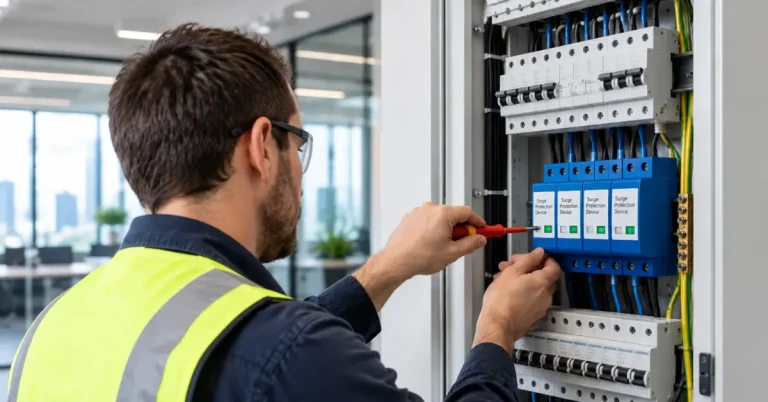
Electrical equipment in a commercial building can be exposed to voltage surges without warning. A single surge can affect sensitive electronics, disrupt business operations and potentially damage expensive electrical equipment.
For businesses that rely on computers, networking equipment, security systems, HVAC controls, machinery and other electronic systems, electrical protection should be considered as part of the building’s overall power infrastructure.
This guide explains what surge protection is, why it matters in commercial buildings, where it can be installed and what businesses should consider when planning electrical protection.
What Is Surge Protection?
Surge protection is designed to help protect electrical systems and connected equipment from short-duration increases in voltage.
Voltage surges can occur for several reasons, including:
- Lightning activity
- Utility or network switching
- Electrical faults
- Switching of large electrical loads
- Problems within a building’s electrical installation
- Sudden changes in power supply conditions
A surge protective device (SPD) provides a path for transient overvoltage energy to be diverted away from sensitive equipment, helping reduce the risk of damage.
Surge protection does not replace other electrical safety measures. Instead, it forms part of a broader approach to protecting a commercial electrical system.
Why Do Commercial Buildings Need Surge Protection?
Modern commercial buildings contain more electronic equipment than ever.
A typical office or commercial property may have:
- Computers and monitors
- Servers and network equipment
- Wi-Fi equipment
- Printers and scanners
- Access control systems
- CCTV and security equipment
- Fire and building management systems
- HVAC controls
- LED lighting controls
- Communications equipment
- Industrial or specialised equipment
Many of these systems contain sensitive electronic components that may be affected by transient voltage events.
Even when a surge does not completely destroy equipment, it may contribute to premature failure or unexpected faults.
For a business, the cost can extend beyond replacing a damaged device. Downtime, lost data, disrupted communications and interrupted operations can also create significant problems.
What Can Cause Electrical Surges?
Lightning
Lightning can create extremely high transient voltages. Direct strikes are particularly severe, but nearby lightning activity can also create induced electrical disturbances.
Switching Large Loads
Commercial and industrial properties often operate equipment with substantial electrical loads.
Switching motors, HVAC systems, compressors and other large loads can produce transient disturbances within an electrical installation.
Utility Switching
Electrical Faults
Fault conditions and switching events within a building can affect the electrical system and connected equipment.
This is why surge protection should be considered based on the property’s electrical environment and equipment—not simply on whether the building is located in an area with frequent storms.
What Is a Surge Protective Device?
A surge protective device, commonly called an SPD, is designed to limit transient overvoltage and divert surge current.
SPDs can be incorporated into an electrical installation at appropriate points to provide protection for different parts of the system.
The right arrangement depends on factors such as:
- The building’s electrical configuration
- Incoming electrical supply
- Existing switchboard arrangement
- Equipment being protected
- Building size
- Exposure to external electrical events
- Existing protection measures
- Risk assessment and installation requirements
A qualified electrical contractor can assess the installation and determine an appropriate protection strategy.
Where Is Surge Protection Installed
Main Switchboard
The main switchboard is often an important location to consider because it is a central point for distributing electrical power throughout the building.
Adding appropriate protection at this level can help protect downstream circuits and equipment.
Sub-Boards
Larger commercial buildings may have multiple distribution boards or sub-boards supplying different areas.
Depending on the installation and protection strategy, additional SPDs may be appropriate at downstream boards.
Sensitive Equipment
Some equipment may require additional consideration because of its sensitivity or importance to business operations.
For example, communications, networking, control and security systems may warrant specific protection arrangements.
A layered approach may provide more comprehensive protection than relying on a single device at one location.
Surge Protection and Commercial Switchboards
The condition and capacity of the existing switchboard should be considered before adding new electrical protection.
An older switchboard may have limited space, outdated components or other issues that need to be addressed as part of the work.
If your property already requires electrical upgrades, it can be useful to assess surge protection at the same time.
For example, businesses planning commercial switchboard upgrades should consider whether surge protection should form part of the broader electrical upgrade rather than treating it as a completely separate project.
For more information about the factors that can influence switchboard work, see our guide to Commercial Switchboard Upgrade Cost: What Perth Businesses Should Know.
How Surge Protection Helps Protect Business Equipment
Computers and IT Equipment
Networking Infrastructure
Security Systems
Building Management Systems
Industrial Equipment
Manufacturing, warehousing and other industrial environments may contain motors, controls and electronic equipment that can be exposed to transient events.
Surge protection is not a guarantee that equipment will never be damaged, but it can form an important part of a property’s electrical protection strategy.
Signs Your Commercial Electrical System May Need Attention
Surge protection is only one part of electrical system management.
Businesses should also pay attention to recurring electrical problems such as:
- Equipment frequently resetting
- Unexpected equipment failures
- Flickering lights
- Tripping circuits
- Damaged outlets or switches
- Overloaded power points
- Heat or burning smells around electrical equipment
- Repeated faults affecting electronic systems
- Problems occurring when large equipment starts or stops
If your business is experiencing these symptoms, the underlying issue should be investigated rather than simply installing surge protection and assuming the problem is resolved.
Our guide to common commercial electrical issues covers other electrical problems that businesses may encounter and what can cause them.
Surge Protection Does Not Fix Every Electrical Problem
It is important to understand the difference between electrical protection and fault correction.
For example, an SPD is not designed to:
- Fix an overloaded circuit
- Repair damaged wiring
- Correct poor electrical connections
- Replace faulty circuit protection
- Resolve an undersized electrical supply
- Fix a defective appliance
- Replace an outdated switchboard
If a commercial property is experiencing ongoing electrical faults, the entire electrical system may need to be assessed.
Surge protection should complement good electrical design, installation, maintenance and testing.
Do You Need Surge Protection in an Office?
Many modern offices rely heavily on electronic systems.
A typical office may depend on:
- Desktop computers
- Laptops and docking stations
- Network switches
- Wi-Fi equipment
- Servers
- Printers
- Video conferencing equipment
- Security systems
- Building management controls
The business impact of losing several of these systems at once can be significant.
When planning a new office, refurbishment or electrical upgrade, surge protection can therefore be considered alongside the property’s broader power and data infrastructure.
Our Power & Data services can help businesses plan electrical and data infrastructure around their current requirements and future needs.
Surge Protection During an Office Fit-Out
A new fit-out is a useful opportunity to review electrical protection before equipment and furniture are installed.
During planning, consider:
- What electrical equipment will be installed?
- Which systems are critical to business operations?
- Where are the main and distribution switchboards?
- Is the existing electrical infrastructure suitable?
- Are there sensitive electronic systems that need additional consideration?
- Will the business add more equipment in the future?
- Does the electrical design provide appropriate protection?
- Are power and data requirements being planned together?
Considering these questions early can help avoid costly changes later.
Commercial Surge Protection Checklist
Before proceeding with surge protection, businesses can review:
- Existing switchboard condition
- Main electrical supply
- Distribution boards
- Existing circuit protection
- Sensitive electronic equipment
- IT and networking infrastructure
- Security and access control systems
- Building management equipment
- HVAC and other large electrical loads
- Potential exposure to transient events
- Existing surge protection
- Future electrical expansion
- Installation requirements
- Ongoing inspection and maintenance considerations
The exact solution should be determined by the property’s electrical installation and the equipment being protected.
When Should a Business Consider Surge Protection?
Surge protection can be considered when:
Building a New Commercial Property
Electrical protection can be incorporated into the initial electrical design.
Renovating or Refitting an Existing Property
A refurbishment provides an opportunity to review existing switchboards and protection measures.
Upgrading a Switchboard
If electrical infrastructure is already being modified, surge protection can be assessed as part of the upgrade.
Installing Sensitive Equipment
Businesses introducing expensive or critical electronic equipment should review their existing electrical protection.
Experiencing Repeated Electrical Problems
Recurring faults or unexplained equipment failures should prompt an electrical assessment.
What About Lightning Protection?
Surge protection and lightning protection are related but are not the same thing.
Surge protective devices address transient overvoltages within an electrical installation. A complete lightning protection strategy may involve additional measures depending on the building, location, structure and risk.
Businesses with significant lightning exposure or critical infrastructure should have their requirements professionally assessed rather than assuming a standard SPD provides complete lightning protection.
Does Every Commercial Building Need the Same Surge Protection?
No.
There is no single surge protection arrangement that is appropriate for every commercial property.
A small office with relatively simple electrical infrastructure may have very different requirements from:
- A warehouse
- A manufacturing facility
- A medical facility
- A data-heavy business
- A multi-storey commercial building
- A property with extensive HVAC systems
- A site with industrial machinery
The protection strategy should reflect the building’s electrical system, equipment and risk profile.
Why Professional Installation Matters
Surge protection needs to be correctly selected, installed and coordinated with the rest of the electrical installation.
An electrical contractor can assess:
- Existing electrical infrastructure
- Switchboard configuration
- Protection requirements
- Equipment loads
- Available switchboard space
- Earthing arrangements
- Existing protective devices
- Future electrical requirements
This helps ensure the solution is appropriate for the property rather than simply adding a device without considering the wider system.
Final Thoughts
Electrical surges can pose a risk to the electronic equipment that modern commercial businesses depend on.
A properly planned surge protection strategy can form part of a broader approach to protecting electrical infrastructure, sensitive equipment and business operations.
However, surge protection should not be viewed in isolation. Switchboards, power distribution, cabling, circuit protection and the property’s overall electrical design all play a role.
If your business is upgrading its electrical infrastructure, experiencing recurring electrical issues or installing sensitive equipment, it may be worth reviewing the property’s existing protection measures.
Improve Electrical Protection for Your Commercial Property
Want to improve electrical protection for your commercial property? Contact Symbient Electrical to discuss your electrical requirements.