

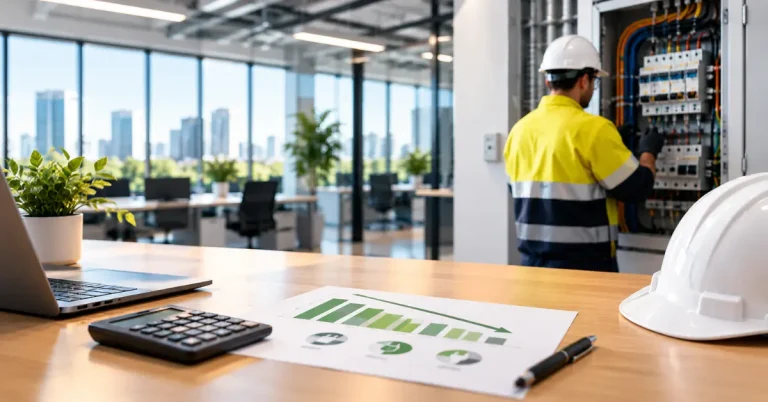
Electricity is a major operating expense for many Australian businesses.
Offices, warehouses, retail properties, workshops and industrial facilities can consume significant amounts of electricity through lighting, air conditioning, equipment, machinery, computers and other electrical systems.
The good news is that reducing electricity costs does not always mean making major changes to the entire building.
Businesses can often improve energy efficiency by identifying where electricity is being consumed, upgrading inefficient equipment, improving lighting, managing operating schedules and reviewing the property’s electrical infrastructure.
This guide explains practical ways to reduce electricity costs in a commercial building and where electrical upgrades can make a difference.
Why Do Commercial Buildings Use So Much Electricity?
Every commercial property is different, but common sources of electricity consumption include:
- Lighting
- Heating, ventilation and air conditioning
- Computers and IT equipment
- Refrigeration
- Motors and machinery
- Hot water systems
- Kitchen equipment
- Pumps and fans
- Security systems
- Building management systems
- Signage and external lighting
The first step towards reducing electricity costs is understanding which systems are consuming the most energy.
Without this information, businesses may spend money upgrading equipment that has relatively little impact on their overall electricity consumption.
1. Upgrade Older Lighting to LED
- Lower energy consumption
- Longer operating life
- Reduced maintenance
- Better lighting control
- Improved lighting quality
- Greater flexibility through sensors and controls
2. Use Lighting Controls
Replacing lights is only part of an efficient lighting strategy.
Businesses can also consider how and when lights operate.
Depending on the property, options may include:
- Occupancy sensors
- Motion sensors
- Timers
- Daylight controls
- Zoned lighting
- Automatic scheduling
- Manual switching by area
For example, lighting an entire floor when only a small section is occupied can result in unnecessary energy consumption.
Controls can help ensure lighting operates when it is actually needed.
3. Review Air Conditioning Usage
Heating and cooling can represent a significant portion of energy consumption in many commercial buildings.
Businesses can review:
- Operating schedules
- Temperature settings
- Zoned control
- Maintenance requirements
- Building occupancy
- Air-conditioning system efficiency
A system operating outside normal business hours, for example, may consume electricity without providing much benefit.
Energy efficiency is not simply about turning systems off. Businesses need to maintain appropriate working conditions while avoiding unnecessary operation.
4. Identify Equipment That Consumes Excessive Energy
Electrical equipment can gradually become an overlooked source of energy consumption.
Depending on the business, this may include:
- Refrigeration
- Compressors
- Pumps
- Fans
- Machinery
- Office equipment
- Kitchen appliances
- Hot water systems
Older equipment may be less efficient than modern alternatives, but replacement should be based on actual energy use and the expected return on investment.
5. Avoid Leaving Equipment Running Unnecessarily
Simple operational changes can sometimes reduce electricity consumption without requiring an electrical upgrade.
Businesses can establish procedures for:
- Switching off unused equipment
- Shutting down computers when appropriate
- Turning off lights in unoccupied areas
- Managing meeting room equipment
- Controlling after-hours HVAC
- Reducing unnecessary standby loads
These measures are particularly useful when combined with automatic controls and clear workplace procedures.
6. Consider an Energy Audit
If a business does not know where its electricity is being consumed, an energy audit can provide a useful starting point.
A commercial energy audit can help identify:
- Major energy-consuming systems
- Inefficient equipment
- Lighting opportunities
- Operating issues
- Potential upgrade opportunities
- Areas where energy consumption could be reduced
Our guide on commercial energy audits explains why energy audits can be valuable for Perth businesses and how they can help identify opportunities for improvement.
Rather than guessing which upgrades will save money, businesses can use an assessment to prioritise areas with greater potential impact.
7. Look at Your Building's Electrical Infrastructure
Energy efficiency is not only about individual appliances.
The property’s broader electrical infrastructure should also be considered.
This may include:
- Switchboards
- Distribution boards
- Lighting circuits
- Power distribution
- Electrical equipment
- Control systems
- Existing cabling
- Capacity requirements
An older electrical installation may not be suitable for a business that has significantly changed how it uses the building.
An electrical assessment can help identify issues that may affect efficiency, reliability or future upgrade plans.
8. Improve Power and Data Planning During a Fit-Out
For businesses moving into a new office or refurbishing an existing workplace, electrical planning provides an opportunity to improve efficiency from the beginning.
Power requirements should be considered alongside:
- Workstations
- IT equipment
- Lighting
- Meeting rooms
- Kitchen facilities
- Security systems
- Data infrastructure
- Future expansion
Good planning can help reduce unnecessary cabling, avoid poorly positioned equipment and create a more practical electrical layout.
Symbient Electrical’s Power & Data services support commercial businesses with electrical power and data infrastructure planning and installation.
9. Consider Smart Lighting and Automation
Commercial buildings can use automation to control when electrical systems operate.
Depending on the property, this may include:
- Automated lighting
- Occupancy detection
- Timed switching
- Daylight-responsive controls
- Building management systems
- Automated HVAC schedules
Automation can reduce unnecessary operation by matching energy use with actual occupancy and business activity.
However, the right system depends on the building and its requirements. More technology does not automatically mean better efficiency.
10. Maintain Electrical Equipment
Poorly maintained equipment can become less reliable and may consume more energy depending on its condition and application.
Regular maintenance can help businesses identify:
- Damaged equipment
- Loose connections
- Overheating
- Faulty components
- Poorly operating systems
- Electrical issues requiring attention
Maintenance also helps businesses identify problems before they result in unexpected equipment failure or operational disruption.
11. Manage After-Hours Electricity Consumption
A commercial property may continue consuming electricity after employees have gone home.
After-hours consumption can come from:
- Lighting
- HVAC
- Servers
- Security systems
- Refrigeration
- Signage
- Hot water systems
- Equipment left in standby mode
Some of these systems need to remain operational. Others may not.
Businesses can review their after-hours electrical consumption and determine which loads are essential and which can be reduced or scheduled.
12. Review High-Load Equipment
Some businesses have equipment that consumes substantially more electricity than typical office equipment.
Examples include:
- Industrial machinery
- Refrigeration systems
- Compressors
- Pumps
- Large HVAC systems
- Workshop equipment
- Production machinery
If electricity costs are high, these larger loads should be investigated rather than focusing only on small office appliances.
For industrial and high-energy businesses, an electrical assessment can help identify where infrastructure or equipment improvements may be appropriate.
13. Balance Energy Savings With Business Requirements
Reducing electricity costs should not compromise the way a business operates.
For example, switching off essential equipment to save electricity could create:
- Equipment damage
- Security problems
- Data loss
- Poor working conditions
- Production delays
- Compliance issues
The goal should be efficient energy use, not simply the lowest possible electricity consumption.
Businesses should identify which systems are essential, which can be optimised and which can be switched off when not required.
14. Monitor Electricity Consumption
You cannot effectively manage what you cannot measure.
Businesses can monitor electricity consumption to identify:
- Peak usage periods
- Unusual consumption
- After-hours loads
- Seasonal changes
- High-energy equipment
- Effects of electrical upgrades
Monitoring can also help businesses determine whether an efficiency improvement is actually producing the expected result.
For larger facilities, sub-metering or more detailed monitoring may provide additional visibility into different areas or systems.
15. Prioritise Improvements Based on ROI
Not every energy-saving measure will provide the same return.
Businesses should consider:
Potential savings + installation cost + expected lifespan + maintenance requirements + business impact
For example, replacing frequently used lighting may provide a different return compared with replacing equipment that operates for only a few hours each week.
A practical energy-efficiency strategy should prioritise improvements that make sense for the building’s actual usage.
Common Mistakes Businesses Make When Trying to Reduce Electricity Costs
Focusing Only on Lighting
LED upgrades can provide valuable savings, but lighting may not be the largest energy consumer in every commercial property.
Buying Equipment Based Only on Purchase Price
A cheaper appliance or system may have higher operating costs over its lifespan.
Ignoring HVAC
Heating and cooling can be a major contributor to electricity consumption, particularly in larger commercial buildings.
Switching Off Essential Systems
Not every electrical load can safely be switched off after hours.
Making Upgrades Without Assessing the Building
Businesses can waste money by upgrading equipment without first identifying where the largest opportunities actually exist.
Forgetting Future Growth
Electrical efficiency planning should consider how the business expects to use the property in the future.
A Practical Commercial Energy-Saving Checklist
- Review electricity consumption
- Identify major electrical loads
- Assess lighting efficiency
- Consider LED upgrades
- Review lighting controls
- Check HVAC operating schedules
- Identify unnecessary after-hours loads
- Review high-energy equipment
- Consider a commercial energy audit
- Check electrical equipment condition
- Review switchboards and distribution
- Monitor electricity consumption
- Consider automation
- Plan upgrades based on ROI
- Consider future business growth
How Much Can a Business Save on Electricity?
There is no single percentage that applies to every Australian business.
Potential savings depend on factors such as:
- Current electricity consumption
- Building size
- Operating hours
- Existing lighting
- HVAC systems
- Equipment efficiency
- Electricity tariffs
- Energy management practices
- Upgrade costs
A business with old lighting and inefficient equipment may have very different savings opportunities from a recently upgraded building.
This is why an assessment of the actual property is more useful than relying on a generic savings percentage.
Should You Upgrade Everything at Once?
Not necessarily.
A staged approach can make sense for many businesses.
For example:
Stage 1: Identify major energy-consuming systems.
Stage 2: Address low-cost operational improvements.
Stage 3: Upgrade high-impact equipment or lighting.
Stage 4: Improve controls and automation.
Stage 5: Monitor results and identify the next opportunity.
This approach can allow businesses to spread investment while measuring the results of each improvement.
When Should a Business Review Its Electrical Efficiency?
A review can be particularly useful when:
- Electricity costs have increased significantly
- The business moves into a new property
- The building is undergoing refurbishment
- Lighting is outdated
- Equipment is being replaced
- The business is expanding
- Energy consumption appears unusually high
- New machinery is being installed
- The property has recurring electrical issues
An efficiency review can also be incorporated into broader electrical planning during a fit-out or infrastructure upgrade.
Final Thoughts
Reducing electricity costs in a commercial building starts with understanding how the property actually uses energy.
Businesses can look at lighting, HVAC, equipment, operating schedules, controls and electrical infrastructure to identify practical opportunities.
For some properties, a simple operational change may be enough. For others, larger improvements such as LED lighting upgrades, equipment replacement, automation or electrical infrastructure work may provide better long-term value.
The important point is to prioritise improvements based on actual energy use, business requirements and expected return on investment.
A professional assessment can help identify where electrical improvements may have the greatest practical impact.
Improve Your Commercial Property's Electrical Efficiency
Looking for practical ways to improve your commercial property’s electrical efficiency? Contact Symbient Electrical to discuss your requirements.