

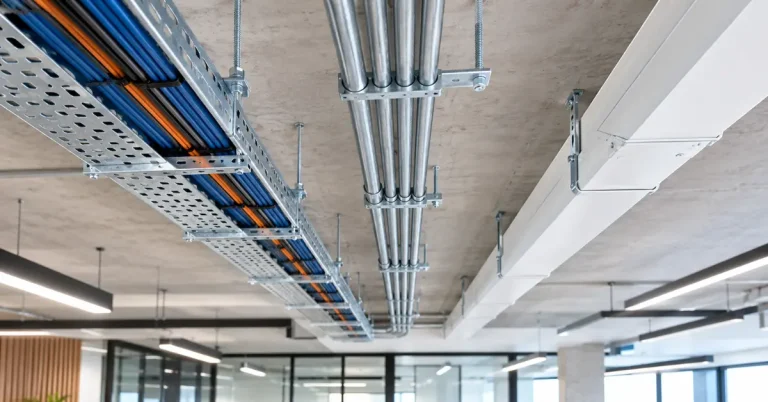
Choosing the right cable management system is an important part of any commercial electrical installation.
Cable tray, conduit and trunking all provide ways to route, support or protect electrical and communications cables, but they are suited to different applications.
For businesses planning an office fit-out, warehouse installation, industrial project or commercial refurbishment, choosing the right containment system can improve cable organisation, accessibility, protection and future expansion.
This guide explains the key differences between cable tray vs conduit vs trunking and when each option may be suitable.
What Is Cable Containment?
Cable containment refers to systems used to route, support and protect electrical or communications cables.
Common options include:
- Cable tray
- Cable ladder
- Conduit
- Cable trunking
- Cable duct
The right option depends on the building, cable types, installation environment, protection requirements and future needs.
Electrical installations in Australia must also meet applicable requirements, including AS/NZS 3000, commonly known as the Wiring Rules.
Cable Tray vs Conduit vs Trunking
Feature | Cable Tray | Conduit | Trunking |
Main purpose | Supports groups of cables | Encloses and protects cables | Routes and encloses multiple cables |
Accessibility | Generally easy to access | More restricted | Usually accessible through covers |
Best suited to | Large cable runs | Protected cable routes | Offices and commercial areas |
Protection | Depends on system and location | Strong enclosed protection | Enclosed protection |
Expansion | Generally flexible | Depends on installation | Good where spare capacity exists |
Appearance | Usually visible | Neat and enclosed | Neat and organised |
These are general characteristics. The right system should always be selected for the specific installation.
What Is Cable Tray?
Cable tray is a support system designed to carry and organise multiple cables along a planned route.
It is commonly considered for larger commercial and industrial installations where several cables need to follow the same pathway.
Advantages of Cable Tray
Handles multiple cables: Suitable for larger cable runs.
Easy access: Cables can generally be inspected and accessed without dismantling an enclosed system.
Supports expansion: A suitably sized tray can allow space for future cables.
Suitable for larger installations: Cable tray may be appropriate for warehouses, industrial facilities, plant rooms, service risers and larger commercial buildings.
Limitations
Cable tray is not suitable for every environment. The design needs to consider:
- Physical protection
- Cable loading
- Environmental conditions
- Available space
- Cable segregation
- Fire and building requirements
- Future access
What Is Conduit?
Conduit is an enclosed pathway through which electrical cables are routed.
It can provide physical protection and a defined cable route, making it useful in various commercial and industrial applications.
Advantages of Conduit
Physical protection: Encloses cables and can help protect them from damage.
Suitable for exposed routes: Useful where cables require a defined and protected pathway.
Neat appearance: Can provide a clean finish where electrical services are visible.
Useful for equipment connections: Conduit can be practical for routing cables to individual items of equipment.
The type of conduit and installation method should be selected according to the environment and applicable requirements.
What Is Cable Trunking?
Cable trunking is an enclosed system designed to route multiple cables.
Unlike conduit, which is generally a tube-like pathway, trunking provides a larger enclosure and can sometimes include separate compartments for different services.
This makes it useful in many office and commercial environments.
Advantages of Trunking
Organises multiple cables: Provides a defined route for electrical and communications cables.
Easy to access: Many systems use removable covers, making future maintenance easier.
Suitable for offices: Trunking can be incorporated into walls, workstations, partitions and other commercial areas.
Neat appearance: It can help keep cables organised and concealed.
Cable Tray vs Conduit: Which Should You Choose?
There is no universal answer to cable tray vs conduit. The right choice depends on the installation.
Cable Tray May Be Suitable When:
- Large numbers of cables need to follow one route
- Easy access is important
- Future cable additions are expected
- There is sufficient installation space
- An exposed support system is acceptable
Conduit May Be Suitable When:
- Cables require an enclosed route
- Additional physical protection is needed
- The cable route is relatively contained
- A neat exposed installation is preferred
- Cables need to be routed to equipment
Trunking May Be Suitable When:
- Multiple cables need to follow one enclosed route
- The installation is within an office or commercial area
- Easy access is important
- Future additions are expected
- A neat appearance is required
Cable Tray vs Trunking
Cable tray and trunking can both carry multiple cables, but they provide different types of containment.
Cable tray is generally an open support system. It is often suited to larger cable routes where accessibility is important.
Trunking provides an enclosed pathway and can be useful in offices and other areas where appearance and cable protection matter.
A commercial project may use both systems in different parts of the building.
Does Cable Management Affect Electrical Safety?
Yes. Cable containment is more than a way to keep an installation tidy.
The cable management system can affect:
- Physical protection
- Cable support
- Heat dissipation
- Cable grouping
- Accessibility
- Maintenance
- Service segregation
- Future modifications
Cable support and containment should therefore be considered during the electrical design rather than added at the end of a project.
Cable Segregation
Commercial buildings can contain several types of cabling, including:
- Electrical power
- Lighting
- Data
- Communications
- Control systems
- Security systems
These services may have different installation and separation requirements.
Electrical and communications cables should not simply be placed together without considering the applicable requirements.
Proper cable pathway planning helps create a more organised and maintainable installation.
Cable Containment for Office Fit-Outs
Office fit-outs often require a combination of power and communications infrastructure.
A typical office may need:
- General power
- Data outlets
- Network infrastructure
- Meeting room connections
- Audio-visual equipment
- Lighting
- Emergency lighting
- Security systems
- Workstation services
Cable containment should be planned around the office layout.
For example, a larger tray system may be used for main cable routes, while trunking or conduit may be used closer to workstations and equipment.
Businesses planning a new workplace should consider containment alongside their office electrical fit-out services rather than treating it as a separate final-stage task.
Cable Management for Warehouses and Industrial Buildings
Warehouses and industrial facilities can have much larger electrical requirements than offices.
Cable routes may need to accommodate:
- Three-phase equipment
- Machinery
- Production systems
- Motors
- Lighting
- Control systems
- Data networks
- Security systems
Cable tray or ladder systems may be suitable for larger service routes, while conduit can be used for specific equipment connections or areas requiring additional protection.
Environmental conditions should also be considered, including:
- Dust
- Moisture
- Heat
- Impact risk
- Chemicals
- Outdoor exposure
Cable Management and Data Cabling
Modern commercial buildings rely heavily on network infrastructure.
Data cabling may include:
- Ethernet
- Fibre optic cabling
- Structured cabling
- Network connections
- Security systems
- Communications infrastructure
Electrical and communications cabling may require appropriate separation depending on the installation.
For businesses installing new electrical and network infrastructure, commercial power and data services can help coordinate these requirements within the overall fit-out.
What Should You Consider Before Choosing Cable Containment?
Before selecting cable tray, conduit or trunking, consider:
1. Number of Cables
Large cable quantities may require a dedicated tray or ladder system.
2. Cable Size
Large power cables can have different support and installation requirements from smaller data or control cables.
3. Installation Environment
Consider whether the cables will be installed in:
- Offices
- Warehouses
- Plant rooms
- Ceiling spaces
- Service risers
- Outdoor areas
- Areas exposed to machinery or impact
4. Future Expansion
If your business is likely to add equipment, workstations or network points, allow for future cable requirements where practical.
5. Accessibility
Consider how easily technicians will be able to inspect, repair or modify the installation.
6. Appearance
In customer-facing offices, the appearance of cable containment may be an important consideration.
7. Protection
The containment system should provide an appropriate level of protection for the installation environment.
8. Service Segregation
Electrical, data and other services may require separation depending on the installation.
9. Building Layout
Cable routes need to be coordinated with ceilings, walls, partitions, HVAC, fire services and structural elements.
10. Future Maintenance
A well-planned containment system should make future inspection and modifications easier.
Common Cable Management Mistakes
Using One System Everywhere
Different areas of a building have different requirements. A combination of containment systems may be more practical.
Ignoring Future Expansion
A cable tray or trunking system with no spare capacity can make future upgrades more difficult.
Poor Cable Organisation
Disorganised cables can make identification, maintenance and troubleshooting harder.
Ignoring Other Building Services
Cable routes should be coordinated with HVAC, fire services, plumbing and structural elements.
Mixing Electrical and Data Cables Without Planning
Electrical and communications cabling can have different installation and separation requirements.
Choosing Only on Price
The cheapest system may not be the most cost-effective over the life of the building.
Consider installation, maintenance, protection, accessibility and future expansion as well as the initial cost.
Can Cable Tray and Conduit Be Used Together?
Yes.
A commercial installation can use different containment systems in different areas.
For example:
Main service route: Cable tray
Branch route: Trunking
Equipment connection: Conduit
Using different systems can allow the containment method to match the requirements of each section of the building.
Cable Containment for a Commercial Fit-Out
Cable containment should be considered early in a commercial fit-out.
A practical planning process includes:
Step 1: Identify Electrical Loads
Determine what equipment and systems will require power.
Step 2: Identify Data Requirements
Map workstations, meeting rooms, communications equipment and other network requirements.
Step 3: Establish Cable Routes
Determine practical pathways through the building.
Step 4: Select Containment
Choose cable tray, conduit, trunking or a combination based on the installation.
Step 5: Coordinate With Other Trades
Check cable routes against ceilings, HVAC, fire services, partitions and structural elements.
Step 6: Allow for Future Expansion
Where practical, allow capacity for additional cabling.
Step 7: Document the Installation
Proper identification and documentation can make future maintenance easier.
Quick Guide: Cable Tray vs Conduit vs Trunking
If your priority is… | Consider |
Large numbers of cables | Cable tray |
Easy access to cable routes | Cable tray |
Enclosed cable protection | Conduit |
Equipment connections | Conduit |
Multiple cables in an enclosed route | Trunking |
Office workstation services | Trunking |
Large plant room routes | Cable tray |
Industrial cable routes | Cable tray or ladder |
Neat commercial installations | Trunking or conduit |
Future cable additions | Tray or suitably sized trunking |
These are general planning considerations. The final choice should be based on the specific project and applicable electrical requirements.
When Should You Speak to a Commercial Electrician?
Professional advice is particularly useful when:
- Planning a new commercial fit-out
- Installing large numbers of circuits
- Adding data cabling
- Expanding an electrical system
- Retrofitting an older building
- Installing machinery
- Creating new cable pathways
- Modifying existing cable tray
- Working in a warehouse or industrial facility
- Coordinating electrical work with other trades
A commercial electrical contractor can assess the building, cable routes, electrical loads and future requirements before recommending a suitable containment strategy.
Final Thoughts
Cable tray, conduit and trunking each have different strengths.
Cable tray is often suitable for larger cable routes where accessibility and expansion are important.
Conduit provides an enclosed pathway and can offer additional physical protection.
Trunking provides an organised, enclosed route for multiple cables and is often useful in office and commercial environments.
For larger projects, the best solution may be a combination of all three.
The decision should consider cable types, installation conditions, protection, accessibility, service segregation, building layout and future expansion—not simply the initial price.
For Perth businesses planning a commercial fit-out, warehouse installation or electrical upgrade, early cable containment planning can help create a more organised and maintainable electrical system.
Need help planning cable containment, power or data infrastructure for a commercial project in Perth? Contact Symbient Electrical to discuss your requirements.
FAQs
What is the difference between cable tray and conduit?
Cable tray is generally an open support system for groups of cables, while conduit provides an enclosed pathway. Cable tray is often suited to larger cable routes, while conduit can provide additional physical protection.
Is cable tray better than conduit?
Neither is automatically better. The choice depends on the number and type of cables, installation environment, protection requirements, accessibility and future expansion.
When should cable trunking be used?
Cable trunking can be useful when multiple cables need to follow an organised, enclosed route. It is commonly considered for office and commercial environments.
Can electrical and data cables share cable tray?
This depends on the installation. Appropriate separation or segregation may be required between electrical and communications cabling, so the pathway should be designed for the specific application.
Is cable tray suitable for office fit-outs?
Yes. Cable tray can be suitable for main cable routes in commercial offices, particularly above ceilings or in service areas. Trunking or conduit may then be used closer to workstations and equipment.
Should cable containment allow for future expansion?
Where practical, yes. Allowing capacity for future cabling can make later electrical and network upgrades easier and reduce installation disruption.
Does cable containment need to comply with Australian standards?
Electrical installations must comply with applicable Australian requirements and standards. AS/NZS 3000, commonly known as the Wiring Rules, sets requirements for electrical installations in Australia and New Zealand. Specific containment requirements depend on the installation and project.